Linguistics with Tia
A rape trial is not only about evidence presented in court; it is also about how that evidence is described, questioned, interpreted, and represented through language. A small difference in wording can change how an event, a complainant, or an accused person is represented.
Consider the difference between “she said she was assaulted” and “the accused assaulted her.” Both sentences refer to an alleged event, but they organize agency differently. The first foregrounds the complainant’s statement, while the second explicitly assigns the action to the accused.
This is why forensic linguistics in rape trials is an important area of language-and-law research. Forensic linguistics examines how linguistic features such as word choice, grammar, agency, passive voice, modality, hedging, questioning, and discourse structure operate in legal and investigative contexts.
For researchers studying rape trial discourse, these linguistic choices can reveal how victims, complainants, and accused persons are constructed within legal narratives.
What is forensic linguistics in rape trials?
Forensic linguistics applies linguistic knowledge to legal and investigative contexts. In rape and sexual-assault cases, linguistic analysis may examine police interviews, witness statements, courtroom questioning, confessions, legal arguments, and judicial judgments.
A forensic linguistic analysis may ask:
-
How is the complainant represented?
-
How is the accused represented?
-
Who receives grammatical agency?
-
Which actions are foregrounded or backgrounded?
-
What words are used to describe each participant?
-
How is credibility represented?
-
How is uncertainty expressed?
-
What assumptions are embedded in questions?
Research on language and sexual violence demonstrates that legal discourse can play an important role in constructing representations of sexual events, consent, identity, agency, and credibility (Ehrlich, 2001; Matoesian, 2001).
The power of word choice
Word choice is one of the most visible features of courtroom language.
Consider expressions such as “stated,” “reported,” “claimed,” “alleged,” “admitted,” and “denied.” These verbs can position information differently within a legal narrative.
For example:
“The complainant claimed that the accused assaulted her.”
The verb claimed can emphasize that the proposition is an assertion made by the complainant rather than an independently established fact.
This does not mean that the word claimed is automatically biased. Courts must distinguish between allegations and facts established through evidence. However, linguistic analysis can examine whether particular terms recur and whether similar language is used consistently for both complainants and accused persons.
This makes lexical choice in legal discourse an important area of analysis.
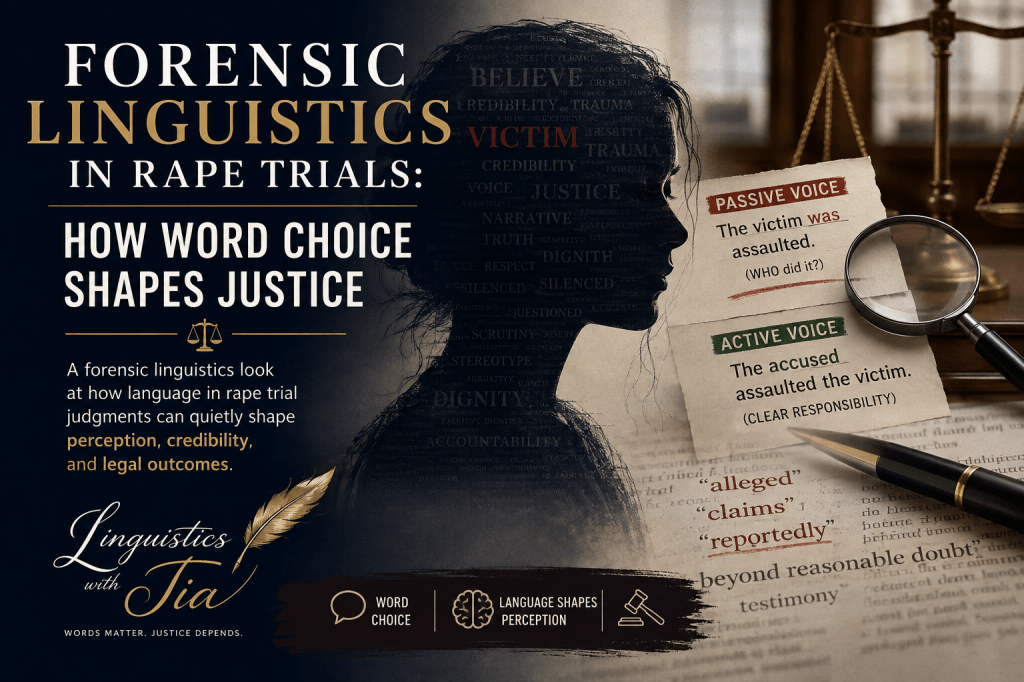
Passive voice and agency
Another important feature is passive voice.
Compare:
“The complainant was assaulted.”
with:
“The accused assaulted the complainant.”
The first sentence uses a passive construction and focuses attention on the person affected by the action. The agent may be omitted. The second sentence uses an active construction and explicitly identifies the accused as the grammatical actor.
Passive voice is not inherently problematic. Legal writing frequently uses passive constructions for legitimate grammatical and stylistic reasons.
However, when examining the linguistic construction of victims and accused persons, researchers can ask whether passive and active constructions systematically distribute agency differently.
Questions include:
Who is represented as acting?
Who is represented as experiencing an action?
Who disappears from the sentence?
Who receives grammatical responsibility?
Such questions are central to discourse analysis of legal judgments.
Hedging language and victim credibility
Hedging is another significant feature of legal language.
Words such as “allegedly,” “reportedly,” “apparently,” “possibly,” “may,” “might,” “claimed,” and “purportedly” can express uncertainty or distance from a proposition.
In rape trials, such language can be particularly important because allegations, testimony, and established facts must be carefully distinguished.
However, researchers can examine whether hedging is distributed evenly.
For instance, does a judgment repeatedly describe the complainant as someone who “claims” something, while the accused is described using more neutral expressions?
The purpose of linguistic analysis is not to assume that such wording automatically demonstrates bias. Rather, it identifies patterns of representation and examines their possible implications.
Language and victim credibility
One of the most sensitive areas of rape trial discourse is the construction of credibility.
Courts may legitimately consider evidence concerning consistency, corroboration, reporting, memory, and other legally relevant factors. However, linguistic analysis can examine how judicial narratives represent these issues.
Researchers may pay attention to references to:
-
Clothing
-
Previous relationships
-
Sexual history
-
Behaviour
-
Emotional responses
-
Delays in reporting
-
Inconsistencies
-
Personal background
The linguistic question is not simply whether such information appears. It is also how much narrative attention it receives and what identity it constructs.
Ehrlich (2001), for example, demonstrates how language in sexual-assault proceedings can contribute to the representation of agency, consent, and gendered assumptions. Her work remains an important foundation for research on language and sexual violence.
Police interviews and legal evidence
Forensic linguistics also operates before a case reaches the courtroom.
Police interviews are important sites where accounts of alleged sexual violence are produced and recorded. The wording of questions can influence how information is elicited and how an account develops.
Haworth (2017), in a detailed analysis of a police interview with a rape suspect, demonstrates how interviewer practices contribute to the discursive construction of evidence, particularly concerning consent.
This means researchers can examine not only what a suspect or witness says, but also how questions are formulated, what assumptions they contain, and how answers are subsequently developed or reformulated.
Forensic Linguistics and Critical Discourse Analysis
Forensic linguistics and Critical Discourse Analysis (CDA) are related but distinct approaches.
Forensic linguistics generally focuses on language-related questions arising in legal and investigative contexts. CDA focuses more on relationships between language, power, ideology, identity, and social structures.
When analyzing rape trial judgments, these approaches can complement one another.
Forensic linguistic analysis may identify patterns involving:
lexical choice → agency → modality → passive voice → evidential framing
CDA can then help interpret how these patterns relate to broader institutional or ideological structures.
Matoesian’s (2001) analysis of the William Kennedy Smith rape trial demonstrates how linguistic practices and cultural assumptions can contribute to the construction of rape as a legal reality.
Why does this matter?
The purpose of analyzing language in rape trials is not to claim that every legal judgment is biased or that every grammatical choice has ideological significance.
Instead, linguistic analysis makes patterns visible.
A single passive construction may be completely ordinary. A single use of claimed may be legally appropriate. A reference to personal history may sometimes be relevant.
But repeated and systematic patterns deserve closer examination.
This matters because legal language shapes how events, evidence, credibility, responsibility, and identities are represented.
Conclusion
Forensic linguistics in rape trials demonstrates that language is an important part of legal meaning.
Word choice, passive voice, agency, hedging, modality, questioning practices, and discourse structure can influence how complainants, accused persons, and alleged events are represented.
Forensic linguistics does not replace legal reasoning or determine guilt or innocence. Instead, it provides systematic tools for examining how language operates within legal and investigative settings.
The central question is therefore not only
“What does the judgment say?”
but also:
“How does the language of the judgment construct what is being represented?”
By asking this question, researchers can better understand the relationship between language, law, power, credibility, gender, and justice.
Bibliography
Ehrlich, S. (2001). Representing rape: Language and sexual consent. Routledge. https://doi.org/10.4324/9780203450437
Haworth, K. (2017). The discursive construction of evidence in police interviews: Case study of a rape suspect. Applied Linguistics, 38(2), 194–214. https://doi.org/10.1093/applin/amv009
Matoesian, G. M. (2001). Law and the language of identity: Discourse in the William Kennedy Smith rape trial. Oxford University Press. https://doi.org/10.1093/oso/9780195123296.001.0001
Shuy, R. W. (2012). The language of sexual misconduct cases. Oxford University Press. https://doi.org/10.1093/acprof:oso/9780199926961.001.0001
 Linguistics with Tia
Leave a comment