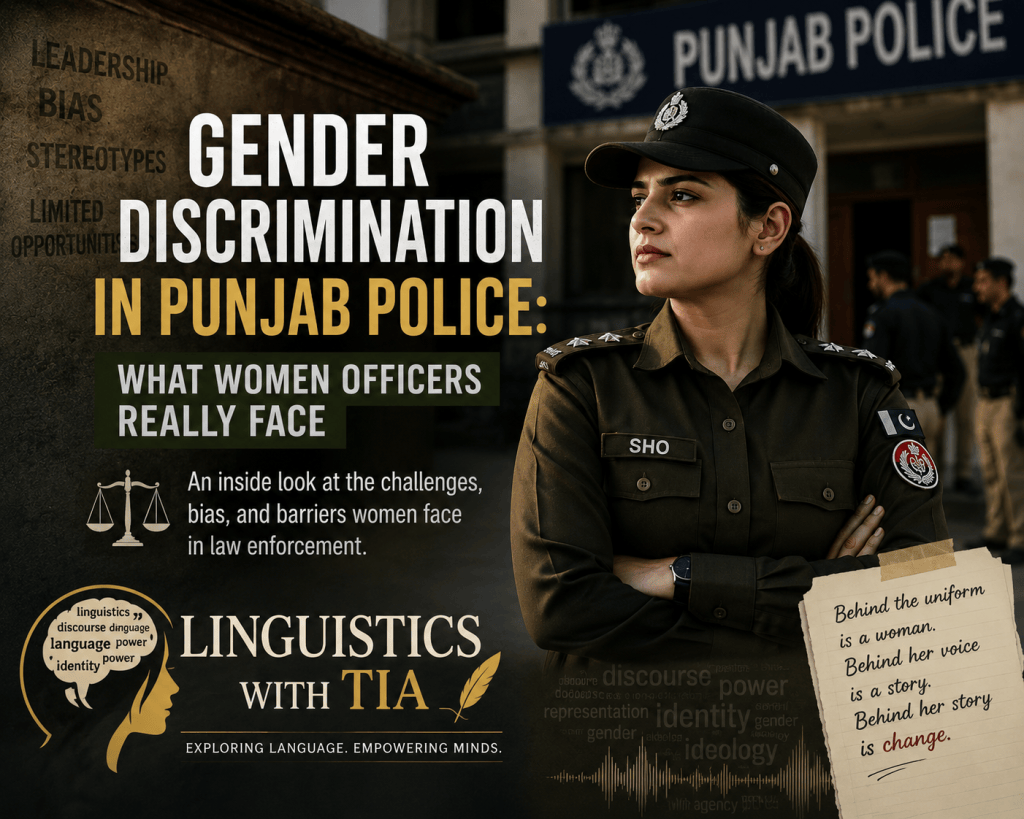
• What Do Women Police Officers Really Face? Gender Discrimination in Punjab Police

    Linguistics with Tia

    Women have been serving in the Punjab Police for decades. They investigate crimes, protect communities, manage police stations, respond to emergencies, and perform many of the same demanding responsibilities as their male colleagues. Yet despite their contributions, women officers still face significant barriers to leadership, professional opportunities, and recognition.

    As a serving Station House Officer (SHO), I have experienced this reality from inside the institution. My experience has taught me that gender discrimination in policing is not always visible or officially documented. Sometimes, it exists in assumptions, attitudes, posting decisions, and the expectations placed on women officers.

    Are leadership roles still seen as “Not for Women”?

    One of the most noticeable challenges for women in policing is access to leadership and operational assignments.

    Positions such as Station House Officer (SHO), Establishment Incharge (OSI), MT Incharge (vehicles), District Security Incharge (DSO), Police Line Muharrar, Line Officer (LO), Reserve Inspector (RI), Incharge of Police Posts (Choki Incharge), and even seemingly routine supervisory assignments can often be perceived as traditionally male roles.

    The problem is not necessarily a written rule saying that women cannot perform these duties as per police rules and police procedures, where it is written only “police officer, not Male Police Officer” The greater problem can be institutional culture and deeply rooted perceptions about what a police officer—or a police leader—should look like.

    When a male police officer receives a demanding assignment, it may be viewed as a normal career progression. When a woman receives the same responsibility, her appointment can sometimes be treated as unusual or requiring justification.

    This difference matters because leadership experience builds professional credibility. If women are consistently excluded from challenging assignments, they also miss opportunities to build the experience needed for future senior positions.

    When Women Officers are treated as a Burden

    Another challenge is the perception that women officers require special management rather than being viewed as professional assets.

    Women in law enforcement may be assigned narrower responsibilities or less visible positions. While every posting has its own operational requirements, a repeated pattern of limited exposure can affect professional development.

    You cannot demonstrate your ability to lead an investigation branch if you are never given the opportunity to work there.

    You cannot build command experience if leadership assignments are consistently considered unsuitable for women.

    And you cannot compete equally for future promotions if you have not been given the same opportunities to demonstrate your abilities.

    Gender equality in policing therefore requires more than recruitment. It requires equal access to meaningful professional assignments, resources, and responsibilities.

    What happens when a woman breaks the barrier?

    Perhaps the hardest part begins when a woman enters a role traditionally dominated by men.

    In my experience, resistance does not always appear openly. Sometimes it takes subtle forms: decisions are questioned more often, authority is undermined, communication becomes unnecessarily dismissive, or expectations rise significantly.

    The challenge is not simply performing the duties of the position. A woman may also find herself managing how others perceive her decisions.

    This creates an additional psychological and professional burden.

    A male officer may be judged primarily on whether the operation succeeded.

    A female officer can sometimes feel that the same outcome is interpreted through the additional question of whether a woman was capable of delivering it.

    What Happens When a Woman Breaks the Barrier?

    Perhaps the most difficult part begins when a woman actually enters a role traditionally dominated by men.

    In my experience, resistance does not always appear openly. Sometimes it takes subtle forms: decisions are questioned more often, authority is undermined, communication becomes unnecessarily dismissive, or expectations rise significantly.

    The challenge is not simply performing the duties of the position. A woman may also find herself managing how others perceive her decisions.

    This creates an additional psychological and professional burden.

    A male officer may be judged primarily on whether the operation succeeded.

    A female officer can sometimes feel that the same outcome is interpreted through the additional question of whether a woman was capable of delivering it.

    That is why women’s leadership in police departments requires cultural change alongside formal equality policies.

    Judged by Gender instead of Performance

    For me, one of the most frustrating aspects of working in a traditionally male-dominated environment has been the feeling that performance can sometimes become secondary to gender.

    During my tenure as SHO at Morgah, my police station maintained a 100% performance record, yet I continued to experience scrutiny and scepticism that, in my view, were influenced by assumptions surrounding women in leadership.

    At one point, I had to say plainly to my seniors:

    “Don’t see me as a female officer. See me as a professional.”

    That sentence represents a much larger issue.

    Women police officers should not have to repeatedly demonstrate that they are exceptions to a stereotype.

    Their professional performance should be evaluated through the same standards applied to their male colleagues.

    The goal should not be to prove that women can perform police duties despite being women. The goal should be to recognize that gender does not determine professional competence.

    Why does Gender Equality in Policing matter?

    Gender discrimination in law enforcement is not limited to Pakistan. Police organizations around the world have struggled with gender imbalance, workplace culture, leadership representation, and unequal perceptions of women officers.

    However, the Pakistani context deserves particular attention.

    Policing operates within a strongly hierarchical institutional environment, while broader social expectations about gender can also influence perceptions of women’s professional roles. These factors can make it particularly difficult for women to enter positions traditionally associated with male authority.

    Increasing the number of women in police departments is therefore only one part of the solution.

    Women also need equal opportunities, meaningful operational assignments, leadership exposure, professional respect, and fair performance evaluation.

    Representation without opportunity is not genuine equality.

    How can Punjab Police support Women Officers?

    Creating a more inclusive police organization requires practical institutional change.

    First, postings and leadership assignments should be based primarily on merit, competence, experience, and performance, rather than assumptions about gender.

    Second, women officers should receive opportunities to work across different branches and operational assignments so they can develop diverse professional experience.

    Third, workplace culture should encourage respectful communication and discourage behavior that undermines an officer’s authority simply because she is a woman.

    Finally, successful women officers should be visible—not as exceptions, but as evidence that leadership in policing is a professional responsibility, not a gendered one.

    Women in Policing: The conversation must continue

    I did not become SHO at a male police station to make a statement. I became SHO to perform my responsibilities professionally.

    But when a woman succeeding in a traditionally male role is considered unusual, simply doing the job well becomes a statement in itself.

    Every woman who enters a challenging police assignment creates an opportunity for the next woman to be judged less by gender and more by performance.

    Women belong wherever their skills, experience, commitment, and professional competence take them—including police leadership.

    This post is part of my ongoing Women in Law Enforcement series, where I share reflections from my experience as a serving SHO in Punjab Police. If you are researching gender discrimination, women in policing, female police leadership, or gender equality in law enforcement, I hope these first-person reflections contribute to a wider conversation about what women officers really face—and what needs to change.


  • What Was My First Day as a Female SHO at Morgah Police Station Really Like? SHO Diaries

    My first day as a woman SHO at Morgah Police Station, Rawalpindi, became more than a posting—it became a defining moment in my career, leadership, and experience of policing in Pakistan.

    Welcome to the first entry of SHO Diaries, a personal series based on my years of experience as a Station House Officer (SHO), Investigation Officer, and police officer in Pakistan.

    This series won’t always be about linguistics. Sometimes, it will be about police leadership, women in law enforcement, criminal justice, institutional culture, public service, and the realities of working inside Pakistan’s policing system.

    That’s where the story begins.

    My First Day as SHO

    It started like any other working day.

    I sat in my office at the Women’s Police Station, working through public complaints and handling my routine responsibilities as an investigation officer and SHO.

    Then my phone rang.

    It was the OSI Sahib.

    “Come quickly,” he said. “CPO Sahib Rawalpindi is waiting for you.”

    I asked him what it was about.

    Before I could get an answer, he hung up.

    I remember wondering what could possibly be so urgent.

    At that point, I had no idea that the phone call was about to change the direction of my career.

    A summons from the CPO

    For readers unfamiliar with police administration in Pakistan, the CPO (Chief Police Officer) holds significant authority over postings and administrative decisions within the district police structure.

    A posting can change your responsibilities, your working environment, and sometimes the entire direction of your professional life.

    So when I received that call, my first reaction wasn’t excitement.

    It was anxiety.

    • Why was the CPO calling me?
    • What had happened?
    • Was there a complaint?
    • Was I being transferred?
    • Was something wrong?

    The OSI called again.

    Then again.

    Three times before I even reached the office.

    By the time I arrived, I discovered that I was the last officer to be seen.

    The other officers who had been summoned had already met the CPO and left.

    I was alone.

    And I was about to find out why they had called me.

    Standing before the Boss

    The OSI walked me directly into the office.

    Inside, the CPO Sahib was seated with two male SHOs and an SP.

    I saluted immediately and stood at attention—the response drilled into you through years of police training and professional discipline.

    Then came the question.

    “Gul, if I post you as SHO at a male police station, what will you do? Can you handle it?”

    There was no long pause.

    I didn’t hesitate.

    “Yes, sir. Better than the male SHOs.”

    The two male SHOs smiled.

    It was the kind of smile that wasn’t exactly a compliment.

    The SP then added:

    “Sir, her enthusiasm and passion are commendable.”

    I understood the undertone.

    But the CPO Sahib appeared genuinely pleased with my confidence.

    Then he said the words that would change my professional journey:

    “Then go. Take charge of Police Station Morgah.”

    That was it.

    No long speech.

    No elaborate ceremony.

    Just one decision.

    But that single sentence marked one of the most important turning points of my career.

    I had been assigned as SHO of a male police station in Rawalpindi.

    And as a woman police officer, I knew that the posting would come with expectations, questions, and challenges.

    What does it mean to be a Woman SHO?

    Being a female SHO in Pakistan is not simply about wearing the uniform and occupying an office.

    An SHO is responsible for much more than running a police station.

    The role involves handling public complaints, crime investigations, law and order, police personnel, victims, accused persons, legal procedures, community concerns, and senior police officers.

    An SHO must make decisions under pressure.

    Sometimes those decisions affect people’s lives, safety, property, and access to justice.

    For a woman leading a traditionally male-dominated police station, there can also be another layer to the job: proving that authority is not determined by gender.

    Leadership has to be demonstrated through competence, discipline, decision-making, communication, and accountability.

    My posting to Morgah would teach me this lesson again and again.

    Walking out into resistance

    I saluted and left the CPO’s office.

    The OSI Sahib was walking beside me.

    I could sense something in his expression.

    It wasn’t congratulations.

    It was closer to discomfort—or perhaps resentment.

    I chose not to focus on it.

    But resistance appeared almost immediately.

    Back at his office, a sub-inspector made a remark that was clearly intended to mock the decision.

    His argument was simple:

    If a woman could be appointed SHO of a male police station, then, by the same logic, why couldn’t a male officer be appointed SHO of a women’s police station?

    The implication was obvious.

    He seemed to suggest that my posting was somehow unusual, inappropriate, or not based entirely on merit.

    I didn’t let the comment pass.

    I asked:

    “Why not?”

    Then I added:

    “If you want that so badly, get yourself made SHO within a week.”

    There was no reply.

    Sometimes, you don’t need a long argument.

    Sometimes, confidence speaks for itself.

    The journey to Morgah Police Station

    After that exchange, something changed.

    Calls of congratulations started coming in.

    People who viewed the posting differently began contacting me and congratulating me on what they considered an important professional opportunity.

    I got into the official vehicle of the Women’s Police Station.

    Then I began the journey to Police Station Morgah, Rawalpindi.

    I was going there to formally take charge as SHO.

    I remember that journey because, although it was simply a drive from one police station to another, it felt much bigger professionally.

    I was leaving one familiar environment and entering a completely different one.

    I was going to lead a police station where I knew my position as a woman would be noticed.

    But I also knew something else.

    I had not been given the posting merely to occupy a chair.

    I had been given responsibility.

    And responsibility has to be earned every day.

    Women in Police leadership

    My experience at Morgah became part of a much larger question:

    Can women lead effectively in traditionally male-dominated policing environments?

    My answer is simple:

    Yes.

    But leadership cannot be reduced to gender.

    A police officer should be judged by professional competence, integrity, decision-making ability, discipline, communication skills, and commitment to public service.

    At the same time, we cannot ignore the reality that women police officers may encounter gender-based assumptions and institutional resistance.

    A woman may sometimes have to demonstrate competence before receiving the same level of recognition that a male officer is automatically assumed to possess.

    That is why stories of women in law enforcement in Pakistan matter.

    They offer a window into experiences rarely discussed outside official statistics, police reports, and institutional documents.

    My experience as a woman SHO taught me that policing is not only about laws and procedures.

    It is also about people, language, power, perception, identity, and authority.

    These themes also connect with my academic interest in linguistics.

    The way people speak to police officers, the way police officers communicate with complainants, and the words institutions use to describe victims, accused persons, witnesses, and communities can reveal much about how authority operates.

    The beginning of SHO Diaries

    At the time, I didn’t fully understand how significant that drive to Morgah would become.

    I only knew that I was going to take charge of a police station.

    But looking back, I now understand that it was the beginning of a chapter that shaped my understanding of police leadership, gender, authority, institutional culture, and public service in Pakistan.

    It also gave me experiences I later connected to my academic work in English linguistics, discourse analysis, and institutional communication.

    The uniform teaches you about authority.

    The police station teaches you about people.

    And experience teaches you that the two are not always the same thing.

    That first day at Morgah was only the beginning.

    There would be difficult investigations, public complaints, unexpected challenges, professional disagreements, moments of pressure, moments of pride, and countless encounters with people from different walks of life.

    Some of those experiences changed the way I understood policing.

    Others changed the way I understood myself.

    And some eventually became stories worth telling.

    What I learned from my First Day as SHO

    Looking back, my first day as SHO at Morgah Police Station taught me several important lessons.

    First, leadership begins with confidence.
    You may not always know what lies ahead, but you must be willing to accept responsibility when the opportunity comes.

    Second, resistance is sometimes part of leadership.
    Not everyone will immediately accept a decision, particularly when it challenges traditional expectations.

    Third, competence speaks louder than stereotypes.
    A police officer’s ability should ultimately be demonstrated through performance, not assumptions about gender.

    Finally, every posting becomes part of your professional story.
    Some assignments are routine. Others become turning points.

    For me, Morgah was a turning point.

    And this is only the first entry.

    Final thoughts

    SHO Diaries is my attempt to document experiences, lessons, challenges, and reflections from my years in policing.

    These stories are not intended to present policing as perfect.

    They are about the realities behind the uniform—the decisions, pressures, people, conflicts, achievements, and lessons that are rarely visible from outside a police station.

    My first day as SHO at Morgah Police Station, Rawalpindi, began with an unexpected phone call from the OSI and ended with me driving toward a completely new professional challenge.

    I didn’t know then where that road would lead.

    But I knew one thing:

    I was ready to take charge.

    And sometimes, that’s exactly where leadership begins.

    Follow SHO Diaries.

    This is SHO Diaries — Entry 1.

    In the upcoming entries, I will share more reflections from my experience of policing in Pakistan, women in law enforcement, police leadership, investigation, public complaints, institutional communication, and life inside a police station.

    Because behind every posting, there is a story.

    And behind every story, there is a lesson.

  • What Is Forensic Linguistics? How Does Language Analysis Solve Real Cases?

    Linguistics with Tia

    A ransom note. An anonymous threatening message. A disputed confession. A suspicious email.

    What if the words themselves could provide evidence?

    This is where forensic linguistics comes in. Forensic linguistics is the application of linguistic knowledge and methods to questions involving law, crime, investigations, and legal communication. It brings together language science and the legal system to examine how words, sentences, writing styles, and communication patterns can provide evidence or clarify disputed questions.

    From identifying the possible author of an anonymous message to examining police interviews and courtroom language, forensic linguistics shows that language can become evidence.

    What Is Forensic Linguistics?

    Forensic linguistics is the application of linguistic analysis to legal and forensic contexts.

    It can involve the study of:

    • Vocabulary and word choice
    • Grammar and sentence structure
    • Spelling and punctuation
    • Discourse patterns
    • Writing style
    • Speech patterns
    • Meaning and interpretation
    • Language variation
    • Questioning techniques
    • Legal and institutional language

    Forensic linguistics sits at the intersection of linguistics, law, and investigation.

    A forensic linguist may be asked questions such as

    • Who is most likely to have written this anonymous message?
    • Does a disputed statement reflect the speaker’s own language?
    • Could a particular wording have influenced how a witness understood a question?
    • What does the language of a legal document actually communicate?

    The answers require systematic linguistic analysis, not intuition alone.

    Why Can Language Become Evidence?

    Everyone develops patterns in how they communicate.

    We make habitual choices about vocabulary, sentence structure, punctuation, spelling, expressions, and even how we organize information.

    These individual patterns are sometimes described through the concept of an idiolect—a person’s distinctive way of using language.

    For example, one person may repeatedly use particular expressions, sentence structures, punctuation habits, or spelling conventions.

    Another person may have a completely different linguistic profile.

    These patterns can sometimes provide useful evidence when investigators compare an anonymous or disputed text with known samples.

    However, an important principle is:

    Linguistic evidence is usually probabilistic, not magical.

    A forensic linguist should not simply say:

    “This person definitely wrote it.”

    Instead, linguistic evidence is generally evaluated in terms of similarities, differences, likelihood, and competing explanations.

    That distinction is essential when language evidence is used in legal contexts.

    Can Word Choice Identify a Writer?

    One of the best-known areas of forensic linguistics is authorship analysis.

    Authorship analysis examines linguistic features in a disputed text and compares them with texts whose authorship is known.

    A forensic linguist may examine:

    1. Vocabulary

    What words does the writer regularly choose?

    2. Function words

    Words such as

    the, of, and, but, however, to

    can be surprisingly informative because writers often use them unconsciously.

    3. Sentence structure

    Does the writer prefer short, direct sentences or longer and more complex structures?

    4. Punctuation

    Does the writer consistently use commas, dashes, brackets, or particular punctuation patterns?

    5. Spelling

    Does the writer make recurring spelling choices or errors?

    6. Grammar

    Does the writer repeatedly use particular grammatical structures?

    7. Dialect and regional features

    Does the writing contain vocabulary or grammatical patterns associated with a particular linguistic background?

    When several features consistently converge, they may help investigators evaluate competing authorship hypotheses.

    The Unabomber Case and Linguistic Evidence

    One of the most famous examples associated with forensic linguistic analysis is the Unabomber investigation.

    The case involved a lengthy manifesto that was published publicly. Linguistic features of the manifesto helped investigators connect the text with Ted Kaczynski’s known writing and background.

    The linguistic evidence was not a simple “fingerprint” that proved authorship on its own.

    Rather, the language provided an important connection between the disputed text and the suspect.

    This case helped bring public attention to the potential value of linguistic analysis in criminal investigations.

    The lesson is important:

    Words can contain clues about their author.

    But responsible forensic analysis requires careful comparison, appropriate data, and awareness of the limits of linguistic evidence.

    Bibliography

    Coulthard, M., Johnson, A., & Wright, D. (2017). An introduction to forensic linguistics: Language in evidence (2nd ed.). Routledge.

    Coulthard, M. (2004). Author identification, idiolect, and linguistic uniqueness. Applied Linguistics, 25(4), 431–447.

    Heydon, G. (2005). The language of police interviewing: A critical analysis. Palgrave Macmillan.

    Juola, P. (2008). Authorship attribution. Foundations and Trends in Information Retrieval, 1(3), 233–334. https://doi.org/10.1561/1500000005

    McMenamin, G. R. (2002). Forensic linguistics: Advances in forensic stylistics. CRC Press.

    Olsson, J. (2008). Forensic linguistics: An introduction to language, crime and the law (2nd ed.). Continuum.

  • How Does Forensic Linguistics Shape Justice in Rape Trials?


                                                               Linguistics with Tia

    A rape trial is not only about evidence presented in court; it is also about how that evidence is described, questioned, interpreted, and represented through language. A small difference in wording can change how an event, a complainant, or an accused person is represented.

    Consider the difference between “she said she was assaulted” and “the accused assaulted her.” Both sentences refer to an alleged event, but they organize agency differently. The first foregrounds the complainant’s statement, while the second explicitly assigns the action to the accused.

    This is why forensic linguistics in rape trials is an important area of language-and-law research. Forensic linguistics examines how linguistic features such as word choice, grammar, agency, passive voice, modality, hedging, questioning, and discourse structure operate in legal and investigative contexts.

    For researchers studying rape trial discourse, these linguistic choices can reveal how victims, complainants, and accused persons are constructed within legal narratives.

    What is forensic linguistics in rape trials?

    Forensic linguistics applies linguistic knowledge to legal and investigative contexts. In rape and sexual-assault cases, linguistic analysis may examine police interviews, witness statements, courtroom questioning, confessions, legal arguments, and judicial judgments.

    A forensic linguistic analysis may ask:

    • How is the complainant represented?

    • How is the accused represented?

    • Who receives grammatical agency?

    • Which actions are foregrounded or backgrounded?

    • What words are used to describe each participant?

    • How is credibility represented?

    • How is uncertainty expressed?

    • What assumptions are embedded in questions?

    Research on language and sexual violence demonstrates that legal discourse can play an important role in constructing representations of sexual events, consent, identity, agency, and credibility (Ehrlich, 2001; Matoesian, 2001).

    The power of word choice

    Word choice is one of the most visible features of courtroom language.

    Consider expressions such as “stated,” “reported,” “claimed,” “alleged,” “admitted,” and “denied.” These verbs can position information differently within a legal narrative.

    For example:

    “The complainant claimed that the accused assaulted her.”

    The verb claimed can emphasize that the proposition is an assertion made by the complainant rather than an independently established fact.

    This does not mean that the word claimed is automatically biased. Courts must distinguish between allegations and facts established through evidence. However, linguistic analysis can examine whether particular terms recur and whether similar language is used consistently for both complainants and accused persons.

    This makes lexical choice in legal discourse an important area of analysis.

    Passive voice and agency

    Another important feature is passive voice.

    Compare:

    “The complainant was assaulted.”

    with:

    “The accused assaulted the complainant.”

    The first sentence uses a passive construction and focuses attention on the person affected by the action. The agent may be omitted. The second sentence uses an active construction and explicitly identifies the accused as the grammatical actor.

    Passive voice is not inherently problematic. Legal writing frequently uses passive constructions for legitimate grammatical and stylistic reasons.

    However, when examining the linguistic construction of victims and accused persons, researchers can ask whether passive and active constructions systematically distribute agency differently.

    Questions include:

    Who is represented as acting?

    Who is represented as experiencing an action?

    Who disappears from the sentence?

    Who receives grammatical responsibility?

    Such questions are central to discourse analysis of legal judgments.

    Hedging language and victim credibility

    Hedging is another significant feature of legal language.

    Words such as “allegedly,” “reportedly,” “apparently,” “possibly,” “may,” “might,” “claimed,” and “purportedly” can express uncertainty or distance from a proposition.

    In rape trials, such language can be particularly important because allegations, testimony, and established facts must be carefully distinguished.

    However, researchers can examine whether hedging is distributed evenly.

    For instance, does a judgment repeatedly describe the complainant as someone who “claims” something, while the accused is described using more neutral expressions?

    The purpose of linguistic analysis is not to assume that such wording automatically demonstrates bias. Rather, it identifies patterns of representation and examines their possible implications.

    Language and victim credibility

    One of the most sensitive areas of rape trial discourse is the construction of credibility.

    Courts may legitimately consider evidence concerning consistency, corroboration, reporting, memory, and other legally relevant factors. However, linguistic analysis can examine how judicial narratives represent these issues.

    Researchers may pay attention to references to:

    • Clothing

    • Previous relationships

    • Sexual history

    • Behaviour

    • Emotional responses

    • Delays in reporting

    • Inconsistencies

    • Personal background

    The linguistic question is not simply whether such information appears. It is also how much narrative attention it receives and what identity it constructs.

    Ehrlich (2001), for example, demonstrates how language in sexual-assault proceedings can contribute to the representation of agency, consent, and gendered assumptions. Her work remains an important foundation for research on language and sexual violence.

    Police interviews and legal evidence

    Forensic linguistics also operates before a case reaches the courtroom.

    Police interviews are important sites where accounts of alleged sexual violence are produced and recorded. The wording of questions can influence how information is elicited and how an account develops.

    Haworth (2017), in a detailed analysis of a police interview with a rape suspect, demonstrates how interviewer practices contribute to the discursive construction of evidence, particularly concerning consent.

    This means researchers can examine not only what a suspect or witness says, but also how questions are formulated, what assumptions they contain, and how answers are subsequently developed or reformulated.

    Forensic Linguistics and Critical Discourse Analysis

    Forensic linguistics and Critical Discourse Analysis (CDA) are related but distinct approaches.

    Forensic linguistics generally focuses on language-related questions arising in legal and investigative contexts. CDA focuses more on relationships between language, power, ideology, identity, and social structures.

    When analyzing rape trial judgments, these approaches can complement one another.

    Forensic linguistic analysis may identify patterns involving:

    lexical choice → agency → modality → passive voice → evidential framing

    CDA can then help interpret how these patterns relate to broader institutional or ideological structures.

    Matoesian’s (2001) analysis of the William Kennedy Smith rape trial demonstrates how linguistic practices and cultural assumptions can contribute to the construction of rape as a legal reality.

    Why does this matter?

    The purpose of analyzing language in rape trials is not to claim that every legal judgment is biased or that every grammatical choice has ideological significance.

    Instead, linguistic analysis makes patterns visible.

    A single passive construction may be completely ordinary. A single use of claimed may be legally appropriate. A reference to personal history may sometimes be relevant.

    But repeated and systematic patterns deserve closer examination.

    This matters because legal language shapes how events, evidence, credibility, responsibility, and identities are represented.

    Conclusion

    Forensic linguistics in rape trials demonstrates that language is an important part of legal meaning.

    Word choice, passive voice, agency, hedging, modality, questioning practices, and discourse structure can influence how complainants, accused persons, and alleged events are represented.

    Forensic linguistics does not replace legal reasoning or determine guilt or innocence. Instead, it provides systematic tools for examining how language operates within legal and investigative settings.

    The central question is therefore not only

    “What does the judgment say?”

    but also:

    “How does the language of the judgment construct what is being represented?”

    By asking this question, researchers can better understand the relationship between language, law, power, credibility, gender, and justice.

                                                                        Bibliography

    Ehrlich, S. (2001). Representing rape: Language and sexual consent. Routledge. https://doi.org/10.4324/9780203450437

    Haworth, K. (2017). The discursive construction of evidence in police interviews: Case study of a rape suspect. Applied Linguistics, 38(2), 194–214. https://doi.org/10.1093/applin/amv009

    Matoesian, G. M. (2001). Law and the language of identity: Discourse in the William Kennedy Smith rape trial. Oxford University Press. https://doi.org/10.1093/oso/9780195123296.001.0001

    Shuy, R. W. (2012). The language of sexual misconduct cases. Oxford University Press. https://doi.org/10.1093/acprof:oso/9780199926961.001.0001