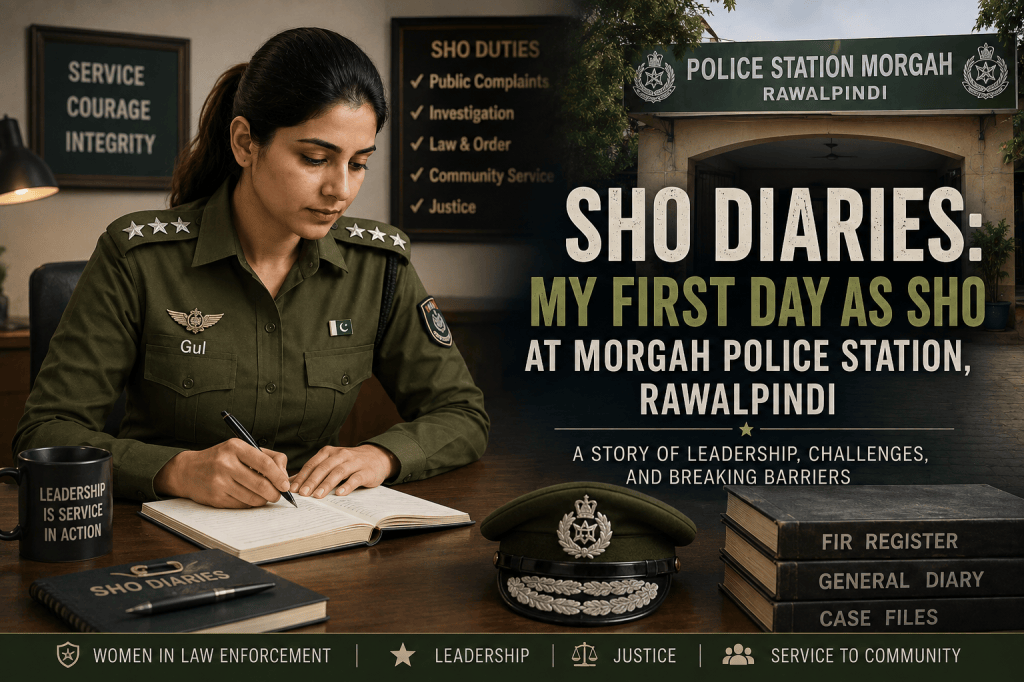
My first day as a woman SHO at Morgah Police Station, Rawalpindi, became more than a posting—it became a defining moment in my career, leadership, and experience of policing in Pakistan.
Welcome to the first entry of SHO Diaries, a personal series based on my years of experience as a Station House Officer (SHO), Investigation Officer, and police officer in Pakistan.
This series won’t always be about linguistics. Sometimes, it will be about police leadership, women in law enforcement, criminal justice, institutional culture, public service, and the realities of working inside Pakistan’s policing system.
That’s where the story begins.
My First Day as SHO
It started like any other working day.
I sat in my office at the Women’s Police Station, working through public complaints and handling my routine responsibilities as an investigation officer and SHO.
Then my phone rang.
It was the OSI Sahib.
“Come quickly,” he said. “CPO Sahib Rawalpindi is waiting for you.”
I asked him what it was about.
Before I could get an answer, he hung up.
I remember wondering what could possibly be so urgent.
At that point, I had no idea that the phone call was about to change the direction of my career.
A summons from the CPO
For readers unfamiliar with police administration in Pakistan, the CPO (Chief Police Officer) holds significant authority over postings and administrative decisions within the district police structure.
A posting can change your responsibilities, your working environment, and sometimes the entire direction of your professional life.
So when I received that call, my first reaction wasn’t excitement.
It was anxiety.
- Why was the CPO calling me?
- What had happened?
- Was there a complaint?
- Was I being transferred?
- Was something wrong?
The OSI called again.
Then again.
Three times before I even reached the office.
By the time I arrived, I discovered that I was the last officer to be seen.
The other officers who had been summoned had already met the CPO and left.
I was alone.
And I was about to find out why they had called me.
Standing before the Boss
The OSI walked me directly into the office.
Inside, the CPO Sahib was seated with two male SHOs and an SP.
I saluted immediately and stood at attention—the response drilled into you through years of police training and professional discipline.
Then came the question.
“Gul, if I post you as SHO at a male police station, what will you do? Can you handle it?”
There was no long pause.
I didn’t hesitate.
“Yes, sir. Better than the male SHOs.”
The two male SHOs smiled.
It was the kind of smile that wasn’t exactly a compliment.
The SP then added:
“Sir, her enthusiasm and passion are commendable.”
I understood the undertone.
But the CPO Sahib appeared genuinely pleased with my confidence.
Then he said the words that would change my professional journey:
“Then go. Take charge of Police Station Morgah.”
That was it.
No long speech.
No elaborate ceremony.
Just one decision.
But that single sentence marked one of the most important turning points of my career.
I had been assigned as SHO of a male police station in Rawalpindi.
And as a woman police officer, I knew that the posting would come with expectations, questions, and challenges.
What does it mean to be a Woman SHO?
Being a female SHO in Pakistan is not simply about wearing the uniform and occupying an office.
An SHO is responsible for much more than running a police station.
The role involves handling public complaints, crime investigations, law and order, police personnel, victims, accused persons, legal procedures, community concerns, and senior police officers.
An SHO must make decisions under pressure.
Sometimes those decisions affect people’s lives, safety, property, and access to justice.
For a woman leading a traditionally male-dominated police station, there can also be another layer to the job: proving that authority is not determined by gender.
Leadership has to be demonstrated through competence, discipline, decision-making, communication, and accountability.
My posting to Morgah would teach me this lesson again and again.
Walking out into resistance
I saluted and left the CPO’s office.
The OSI Sahib was walking beside me.
I could sense something in his expression.
It wasn’t congratulations.
It was closer to discomfort—or perhaps resentment.
I chose not to focus on it.
But resistance appeared almost immediately.
Back at his office, a sub-inspector made a remark that was clearly intended to mock the decision.
His argument was simple:
If a woman could be appointed SHO of a male police station, then, by the same logic, why couldn’t a male officer be appointed SHO of a women’s police station?
The implication was obvious.
He seemed to suggest that my posting was somehow unusual, inappropriate, or not based entirely on merit.
I didn’t let the comment pass.
I asked:
“Why not?”
Then I added:
“If you want that so badly, get yourself made SHO within a week.”
There was no reply.
Sometimes, you don’t need a long argument.
Sometimes, confidence speaks for itself.
The journey to Morgah Police Station
After that exchange, something changed.
Calls of congratulations started coming in.
People who viewed the posting differently began contacting me and congratulating me on what they considered an important professional opportunity.
I got into the official vehicle of the Women’s Police Station.
Then I began the journey to Police Station Morgah, Rawalpindi.
I was going there to formally take charge as SHO.
I remember that journey because, although it was simply a drive from one police station to another, it felt much bigger professionally.
I was leaving one familiar environment and entering a completely different one.
I was going to lead a police station where I knew my position as a woman would be noticed.
But I also knew something else.
I had not been given the posting merely to occupy a chair.
I had been given responsibility.
And responsibility has to be earned every day.
Women in Police leadership
My experience at Morgah became part of a much larger question:
Can women lead effectively in traditionally male-dominated policing environments?
My answer is simple:
Yes.
But leadership cannot be reduced to gender.
A police officer should be judged by professional competence, integrity, decision-making ability, discipline, communication skills, and commitment to public service.
At the same time, we cannot ignore the reality that women police officers may encounter gender-based assumptions and institutional resistance.
A woman may sometimes have to demonstrate competence before receiving the same level of recognition that a male officer is automatically assumed to possess.
That is why stories of women in law enforcement in Pakistan matter.
They offer a window into experiences rarely discussed outside official statistics, police reports, and institutional documents.
My experience as a woman SHO taught me that policing is not only about laws and procedures.
It is also about people, language, power, perception, identity, and authority.
These themes also connect with my academic interest in linguistics.
The way people speak to police officers, the way police officers communicate with complainants, and the words institutions use to describe victims, accused persons, witnesses, and communities can reveal much about how authority operates.
The beginning of SHO Diaries
At the time, I didn’t fully understand how significant that drive to Morgah would become.
I only knew that I was going to take charge of a police station.
But looking back, I now understand that it was the beginning of a chapter that shaped my understanding of police leadership, gender, authority, institutional culture, and public service in Pakistan.
It also gave me experiences I later connected to my academic work in English linguistics, discourse analysis, and institutional communication.
The uniform teaches you about authority.
The police station teaches you about people.
And experience teaches you that the two are not always the same thing.
That first day at Morgah was only the beginning.
There would be difficult investigations, public complaints, unexpected challenges, professional disagreements, moments of pressure, moments of pride, and countless encounters with people from different walks of life.
Some of those experiences changed the way I understood policing.
Others changed the way I understood myself.
And some eventually became stories worth telling.
What I learned from my First Day as SHO
Looking back, my first day as SHO at Morgah Police Station taught me several important lessons.
First, leadership begins with confidence.
You may not always know what lies ahead, but you must be willing to accept responsibility when the opportunity comes.
Second, resistance is sometimes part of leadership.
Not everyone will immediately accept a decision, particularly when it challenges traditional expectations.
Third, competence speaks louder than stereotypes.
A police officer’s ability should ultimately be demonstrated through performance, not assumptions about gender.
Finally, every posting becomes part of your professional story.
Some assignments are routine. Others become turning points.
For me, Morgah was a turning point.
And this is only the first entry.
Final thoughts
SHO Diaries is my attempt to document experiences, lessons, challenges, and reflections from my years in policing.
These stories are not intended to present policing as perfect.
They are about the realities behind the uniform—the decisions, pressures, people, conflicts, achievements, and lessons that are rarely visible from outside a police station.
My first day as SHO at Morgah Police Station, Rawalpindi, began with an unexpected phone call from the OSI and ended with me driving toward a completely new professional challenge.
I didn’t know then where that road would lead.
But I knew one thing:
I was ready to take charge.
And sometimes, that’s exactly where leadership begins.
Follow SHO Diaries.
This is SHO Diaries — Entry 1.
In the upcoming entries, I will share more reflections from my experience of policing in Pakistan, women in law enforcement, police leadership, investigation, public complaints, institutional communication, and life inside a police station.
Because behind every posting, there is a story.
And behind every story, there is a lesson.
 Linguistics with Tia