Linguistics with Tia
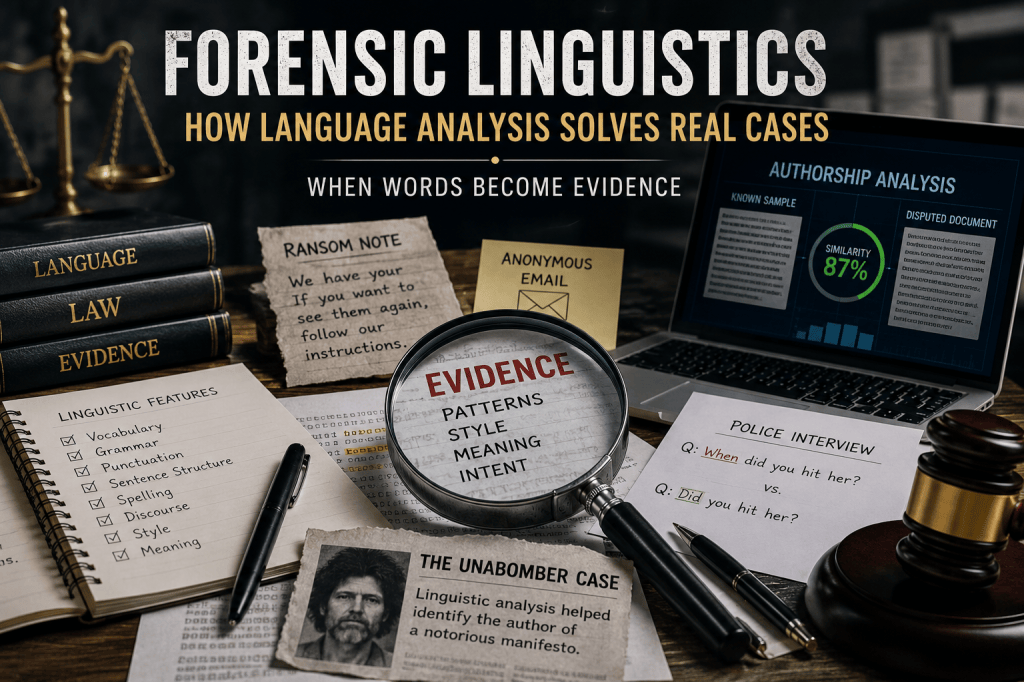
A ransom note. An anonymous threatening message. A disputed confession. A suspicious email.
What if the words themselves could provide evidence?
This is where forensic linguistics comes in. Forensic linguistics is the application of linguistic knowledge and methods to questions involving law, crime, investigations, and legal communication. It brings together language science and the legal system to examine how words, sentences, writing styles, and communication patterns can provide evidence or clarify disputed questions.
From identifying the possible author of an anonymous message to examining police interviews and courtroom language, forensic linguistics shows that language can become evidence.
What Is Forensic Linguistics?
Forensic linguistics is the application of linguistic analysis to legal and forensic contexts.
It can involve the study of:
- Vocabulary and word choice
- Grammar and sentence structure
- Spelling and punctuation
- Discourse patterns
- Writing style
- Speech patterns
- Meaning and interpretation
- Language variation
- Questioning techniques
- Legal and institutional language
Forensic linguistics sits at the intersection of linguistics, law, and investigation.
A forensic linguist may be asked questions such as
- Who is most likely to have written this anonymous message?
- Does a disputed statement reflect the speaker’s own language?
- Could a particular wording have influenced how a witness understood a question?
- What does the language of a legal document actually communicate?
The answers require systematic linguistic analysis, not intuition alone.
Why Can Language Become Evidence?
Everyone develops patterns in how they communicate.
We make habitual choices about vocabulary, sentence structure, punctuation, spelling, expressions, and even how we organize information.
These individual patterns are sometimes described through the concept of an idiolect—a person’s distinctive way of using language.
For example, one person may repeatedly use particular expressions, sentence structures, punctuation habits, or spelling conventions.
Another person may have a completely different linguistic profile.
These patterns can sometimes provide useful evidence when investigators compare an anonymous or disputed text with known samples.
However, an important principle is:
Linguistic evidence is usually probabilistic, not magical.
A forensic linguist should not simply say:
“This person definitely wrote it.”
Instead, linguistic evidence is generally evaluated in terms of similarities, differences, likelihood, and competing explanations.
That distinction is essential when language evidence is used in legal contexts.
Can Word Choice Identify a Writer?
One of the best-known areas of forensic linguistics is authorship analysis.
Authorship analysis examines linguistic features in a disputed text and compares them with texts whose authorship is known.
A forensic linguist may examine:
1. Vocabulary
What words does the writer regularly choose?
2. Function words
Words such as
the, of, and, but, however, to
can be surprisingly informative because writers often use them unconsciously.
3. Sentence structure
Does the writer prefer short, direct sentences or longer and more complex structures?
4. Punctuation
Does the writer consistently use commas, dashes, brackets, or particular punctuation patterns?
5. Spelling
Does the writer make recurring spelling choices or errors?
6. Grammar
Does the writer repeatedly use particular grammatical structures?
7. Dialect and regional features
Does the writing contain vocabulary or grammatical patterns associated with a particular linguistic background?
When several features consistently converge, they may help investigators evaluate competing authorship hypotheses.
The Unabomber Case and Linguistic Evidence
One of the most famous examples associated with forensic linguistic analysis is the Unabomber investigation.
The case involved a lengthy manifesto that was published publicly. Linguistic features of the manifesto helped investigators connect the text with Ted Kaczynski’s known writing and background.
The linguistic evidence was not a simple “fingerprint” that proved authorship on its own.
Rather, the language provided an important connection between the disputed text and the suspect.
This case helped bring public attention to the potential value of linguistic analysis in criminal investigations.
The lesson is important:
Words can contain clues about their author.
But responsible forensic analysis requires careful comparison, appropriate data, and awareness of the limits of linguistic evidence.
Bibliography
Coulthard, M., Johnson, A., & Wright, D. (2017). An introduction to forensic linguistics: Language in evidence (2nd ed.). Routledge.
Coulthard, M. (2004). Author identification, idiolect, and linguistic uniqueness. Applied Linguistics, 25(4), 431–447.
Heydon, G. (2005). The language of police interviewing: A critical analysis. Palgrave Macmillan.
Juola, P. (2008). Authorship attribution. Foundations and Trends in Information Retrieval, 1(3), 233–334. https://doi.org/10.1561/1500000005
McMenamin, G. R. (2002). Forensic linguistics: Advances in forensic stylistics. CRC Press.
Olsson, J. (2008). Forensic linguistics: An introduction to language, crime and the law (2nd ed.). Continuum.
 Linguistics with Tia