Linguistics with Tia
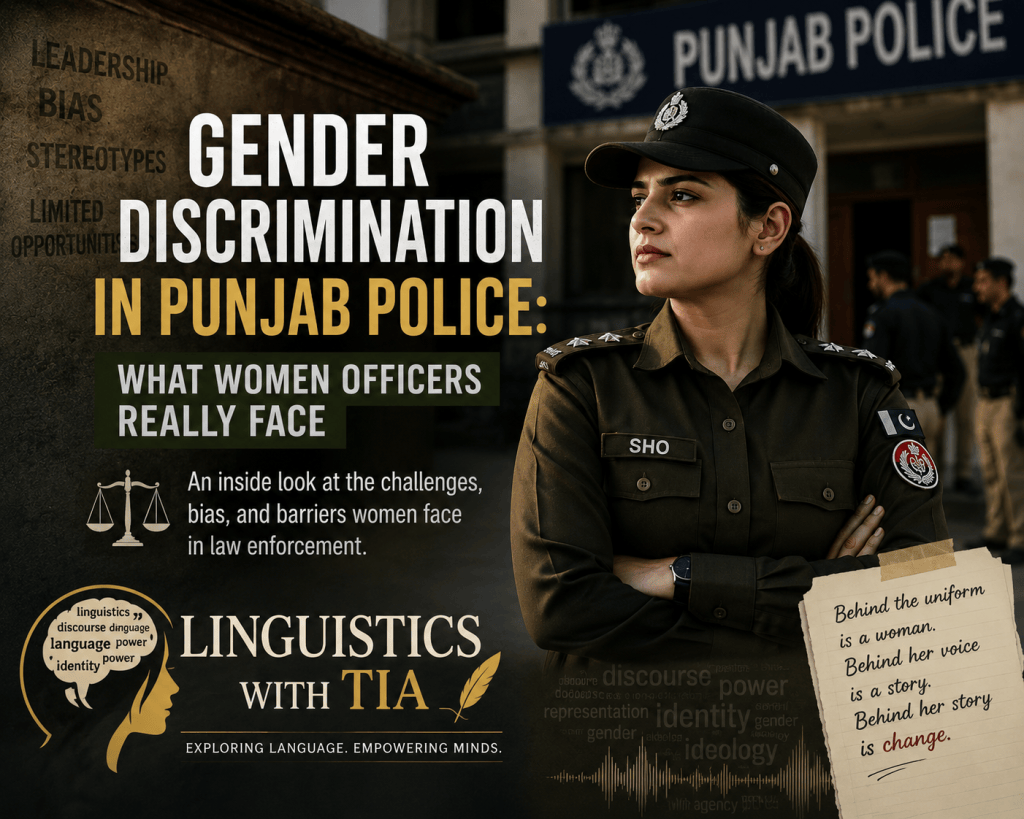
Women have been serving in the Punjab Police for decades. They investigate crimes, protect communities, manage police stations, respond to emergencies, and perform many of the same demanding responsibilities as their male colleagues. Yet despite their contributions, women officers still face significant barriers to leadership, professional opportunities, and recognition.
As a serving Station House Officer (SHO), I have experienced this reality from inside the institution. My experience has taught me that gender discrimination in policing is not always visible or officially documented. Sometimes, it exists in assumptions, attitudes, posting decisions, and the expectations placed on women officers.
Are leadership roles still seen as “Not for Women”?
One of the most noticeable challenges for women in policing is access to leadership and operational assignments.
Positions such as Station House Officer (SHO), Establishment Incharge (OSI), MT Incharge (vehicles), District Security Incharge (DSO), Police Line Muharrar, Line Officer (LO), Reserve Inspector (RI), Incharge of Police Posts (Choki Incharge), and even seemingly routine supervisory assignments can often be perceived as traditionally male roles.
The problem is not necessarily a written rule saying that women cannot perform these duties as per police rules and police procedures, where it is written only “police officer, not Male Police Officer” The greater problem can be institutional culture and deeply rooted perceptions about what a police officer—or a police leader—should look like.
When a male police officer receives a demanding assignment, it may be viewed as a normal career progression. When a woman receives the same responsibility, her appointment can sometimes be treated as unusual or requiring justification.
This difference matters because leadership experience builds professional credibility. If women are consistently excluded from challenging assignments, they also miss opportunities to build the experience needed for future senior positions.
When Women Officers are treated as a Burden
Another challenge is the perception that women officers require special management rather than being viewed as professional assets.
Women in law enforcement may be assigned narrower responsibilities or less visible positions. While every posting has its own operational requirements, a repeated pattern of limited exposure can affect professional development.
You cannot demonstrate your ability to lead an investigation branch if you are never given the opportunity to work there.
You cannot build command experience if leadership assignments are consistently considered unsuitable for women.
And you cannot compete equally for future promotions if you have not been given the same opportunities to demonstrate your abilities.
Gender equality in policing therefore requires more than recruitment. It requires equal access to meaningful professional assignments, resources, and responsibilities.
What happens when a woman breaks the barrier?
Perhaps the hardest part begins when a woman enters a role traditionally dominated by men.
In my experience, resistance does not always appear openly. Sometimes it takes subtle forms: decisions are questioned more often, authority is undermined, communication becomes unnecessarily dismissive, or expectations rise significantly.
The challenge is not simply performing the duties of the position. A woman may also find herself managing how others perceive her decisions.
This creates an additional psychological and professional burden.
A male officer may be judged primarily on whether the operation succeeded.
A female officer can sometimes feel that the same outcome is interpreted through the additional question of whether a woman was capable of delivering it.
What Happens When a Woman Breaks the Barrier?
Perhaps the most difficult part begins when a woman actually enters a role traditionally dominated by men.
In my experience, resistance does not always appear openly. Sometimes it takes subtle forms: decisions are questioned more often, authority is undermined, communication becomes unnecessarily dismissive, or expectations rise significantly.
The challenge is not simply performing the duties of the position. A woman may also find herself managing how others perceive her decisions.
This creates an additional psychological and professional burden.
A male officer may be judged primarily on whether the operation succeeded.
A female officer can sometimes feel that the same outcome is interpreted through the additional question of whether a woman was capable of delivering it.
That is why women’s leadership in police departments requires cultural change alongside formal equality policies.
Judged by Gender instead of Performance
For me, one of the most frustrating aspects of working in a traditionally male-dominated environment has been the feeling that performance can sometimes become secondary to gender.
During my tenure as SHO at Morgah, my police station maintained a 100% performance record, yet I continued to experience scrutiny and scepticism that, in my view, were influenced by assumptions surrounding women in leadership.
At one point, I had to say plainly to my seniors:
“Don’t see me as a female officer. See me as a professional.”
That sentence represents a much larger issue.
Women police officers should not have to repeatedly demonstrate that they are exceptions to a stereotype.
Their professional performance should be evaluated through the same standards applied to their male colleagues.
The goal should not be to prove that women can perform police duties despite being women. The goal should be to recognize that gender does not determine professional competence.
Why does Gender Equality in Policing matter?
Gender discrimination in law enforcement is not limited to Pakistan. Police organizations around the world have struggled with gender imbalance, workplace culture, leadership representation, and unequal perceptions of women officers.
However, the Pakistani context deserves particular attention.
Policing operates within a strongly hierarchical institutional environment, while broader social expectations about gender can also influence perceptions of women’s professional roles. These factors can make it particularly difficult for women to enter positions traditionally associated with male authority.
Increasing the number of women in police departments is therefore only one part of the solution.
Women also need equal opportunities, meaningful operational assignments, leadership exposure, professional respect, and fair performance evaluation.
Representation without opportunity is not genuine equality.
How can Punjab Police support Women Officers?
Creating a more inclusive police organization requires practical institutional change.
First, postings and leadership assignments should be based primarily on merit, competence, experience, and performance, rather than assumptions about gender.
Second, women officers should receive opportunities to work across different branches and operational assignments so they can develop diverse professional experience.
Third, workplace culture should encourage respectful communication and discourage behavior that undermines an officer’s authority simply because she is a woman.
Finally, successful women officers should be visible—not as exceptions, but as evidence that leadership in policing is a professional responsibility, not a gendered one.
Women in Policing: The conversation must continue
I did not become SHO at a male police station to make a statement. I became SHO to perform my responsibilities professionally.
But when a woman succeeding in a traditionally male role is considered unusual, simply doing the job well becomes a statement in itself.
Every woman who enters a challenging police assignment creates an opportunity for the next woman to be judged less by gender and more by performance.
Women belong wherever their skills, experience, commitment, and professional competence take them—including police leadership.
This post is part of my ongoing Women in Law Enforcement series, where I share reflections from my experience as a serving SHO in Punjab Police. If you are researching gender discrimination, women in policing, female police leadership, or gender equality in law enforcement, I hope these first-person reflections contribute to a wider conversation about what women officers really face—and what needs to change.
 Linguistics with Tia